M1 Max vs Nvidia RTX 3080
Apple has unleashed two new processors for Macs: the M1 Pro and the M1 Max. These homegrown Arm-based chips are revamped, and much larger, versions of the M1 launched last year, and include memory, CPU, and GPU all under one roof.
When running a Tomb Raider benchmark at 1440p, the M1 Max with a 32-core GPU attains 83FPS, while a laptop RTX 3060 with a 70W power limit achieves 79FPS, with a 100W RTX 3080 outperforming both with a 112FPS result. The M1 Pro with a 14-core GPU is the slowest out of the bunch, only managing 57FPS.Also, keep in mind that these are low-powered NVIDIA RTX GPUs, and some laptop manufacturers use 115W RTX 3060 and 150W RTX 3080 units, which will undoubtedly crush the low-powered counterparts thanks to their higher power limits. Even in the Geekbench results, the M1 Max cannot even beat the 70W RTX 3060, which is plain disappointing. Fortunately, both the M1 Max and M1 Pro manage to beat NVIDIA’s RTX GPUs in GFXBench 5.0, but we believe that is because some benchmarks favor certain chips over others.

Apple even says its new GPU is a match for Nvidia's RTX 3080 mobile chip, though you'll have to take Apple's word for it on that one. We've also reached out to Nvidia to see what it might have to say on the matter.
The M1 Max is the larger of the two chips, or rather system-on-chips (SoCs), at a whopping 57 billion transistors, and that means it comes with the most memory, most cores, and claims the largest performance wins. It's a 10-core CPU with eight performance cores and two efficiency cores, a 32-core GPU, and up to 64GB of memory.
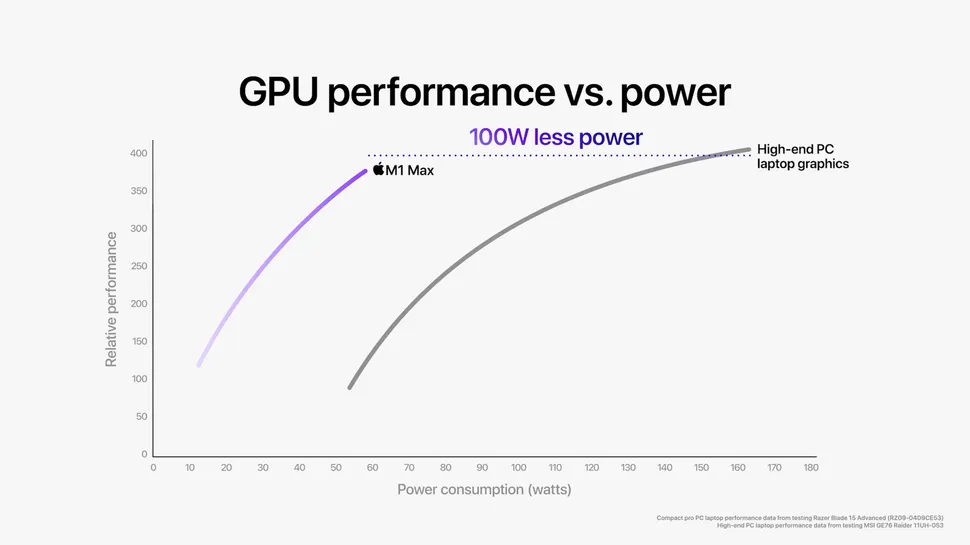
And Apple says that's enough to deliver "performance similar to that of the highest-end GPU in the largest PC laptops while using up to 100 watts less power."
Check out its graph to prove it. Just bear in mind Apple is not offering any indication of the benchmarks it used to gather these figures, only that it collected them "using select industry-standard benchmarks". So, exciting to look at, but not really all that useful.
The bigger story out of Apple's Mac announcement event perhaps is the touted power demands of the M1 Max and M1 Pro, which are far lower than their competition. Again, context is everything, but from an already power-savvy design with the M1 to the use of TSMC's latest 5nm process node, it makes sense as to how Apple could be saving so much while still stuffing so many transistors in.
No doubt these two chips are an impressive feat of engineering, and they're also pretty stunning ones, too. Just don't get hung up on the price too much, the M1 Max will set you back at least $3,499. As for their impact on PC gaming, well, you probably won't hear much more about them, but you could look to Apple's current success with its own Arm-powered chips as a benefit to PC gaming, in a way: If kicking Intel out of Macs has put more pressure on Intel to deliver bigger and better chips, which it most certainly has, that's only to the benefit of us lot buying PCs and laptops with Intel inside.

No comments:
Post a Comment